
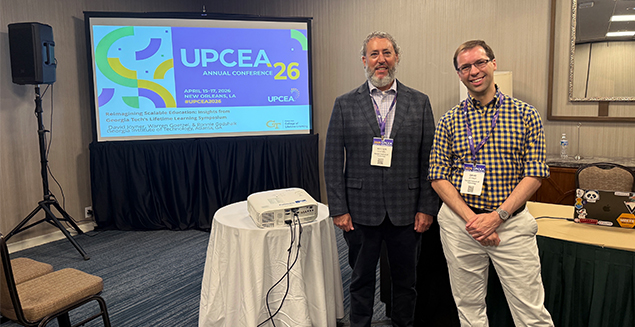
In April, two of the Lifetime Learning Symposium’s co-chairs took the stage at the 2026 UPCEA Annual Conference in New Orleans to share how the upcoming event is evolving into a national platform for thought leaders to discuss the future of learning.
The conversation around what the College of Lifetime Learning is building has hit the road.
Earlier this month, two of the Lifetime Learning Symposium’s co-chairs — Warren Goetzel, director of external and faculty engagement for the College’s Center for 21st Century Learning, and David Joyner, executive director of Online Education & Online Master of Science in Computer Science for the College of Computing — took the stage at the 2026 UPCEA Annual Conference in New Orleans to share how the upcoming event is evolving into a national platform for thought leaders across education, industry, and policy to collaborate on the future of learning.
The symposium has expanded its focus in recent years to explore how institutions can design more connected, relevant learning models that meet people where they are in their lives rather than at the initial point of enrollment.
“Higher education is being called to think bigger about its programs, systems, and credentials,” Goetzel said. “Here at the College, we are building something that encourages leaders and educators to move beyond isolated innovation and toward a shared vision for how learning supports people across their entire lives.”
This year’s symposium — Building a Learning Society — explores how continuous learning is essential to the progress of both individuals and organizations. Through forward-thinking sessions, the event will challenge assumptions, share real-world models, and discuss actionable strategies to build a true learning society without age, geography, or traditional pathway barriers.
Proposals are now open to those interested in contributing to this work. Submissions should align with this year’s focus areas:
- Activating the Learning Lifecycle
How institutions design systems that support learning across every stage of life. - Actualizing Access Through Scale
How we expand access to high-quality learning without sacrificing impact. - Authoring the New Credentialing Landscape
How credentialing evolves to support trust, mobility, and learner agency.
Selected sessions will contribute to a growing, cross-sector effort that aims to define what a learning society looks like in practice.
Proposals should be 200–300 words and are due by Friday, May 29. More information is available here.